







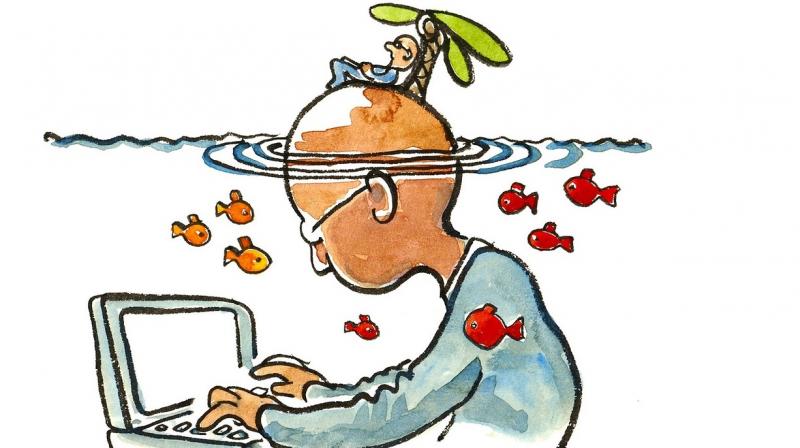
Daydreaming is a Superpower
How Wandering Minds Lead to Breakthrough Ideas.

Stop feeling guilty for staring out the window. Science shows that "zoned out" moments are when your brain is actually working its hardest on creative problems.
Pay attention!"
"Stop staring into space!"
"Focus!"
If you are a student, you have probably heard these commands a thousand times. We are taught that a wandering mind is a bad thing—a sign of laziness or lack of focus. But neuroscientists are discovering that daydreaming is actually a heavy-duty cognitive workout.
The Default Mode Network (DMN)
When you focus hard on a math problem, your brain uses its "Executive Attention Network." It is laser-focused but narrow.
However, when you zone out—while washing dishes, walking the dog, or staring out the bus window—your brain switches to the Default Mode Network (DMN).
Contrary to popular belief, your brain doesn't shut off during this time. It actually lights up like a Christmas tree. The DMN connects disparate parts of the brain that usually don't talk to each other. It digs through your memories, your future plans, and your random knowledge, trying to find patterns.
Why "Aha!" Moments Happen in the Shower
Have you ever struggled with a difficult homework problem for hours, given up, and then suddenly realized the answer while you were brushing your teeth?
That is the DMN in action.
When you focus too hard, you get "tunnel vision." You are staring so closely at the problem that you can't see the solution. By stepping away and letting your mind wander (Incubation), you allow your subconscious to rearrange the information and present the solution.
How to Daydream Productively
This doesn't mean you should fall asleep in class. There is a difference between distraction (scrolling TikTok) and constructive daydreaming.
The Input Phase: You must study the material first. You need to load the information into your brain.
The Incubation Phase: Step away from screens. Go for a walk without headphones. Sit in a quiet room. Let your mind get bored.
The Capture Phase: Always keep a notebook or voice memo app ready. The DMN produces ideas quickly, and if you don't catch them, they vanish.
The Takeaway:
Boredom is not the enemy; it is the soil where creativity grows. Give yourself permission to do "nothing" for 15 minutes a day. Your brain might just surprise you.
More from Curiosity Captain
Curiosity Killed the Boredom !
13 Dec 2025
What If Robots Were Your Best ...
13 Dec 2025
Design Your Future: How Kids ...
13 Dec 2025

.png)